

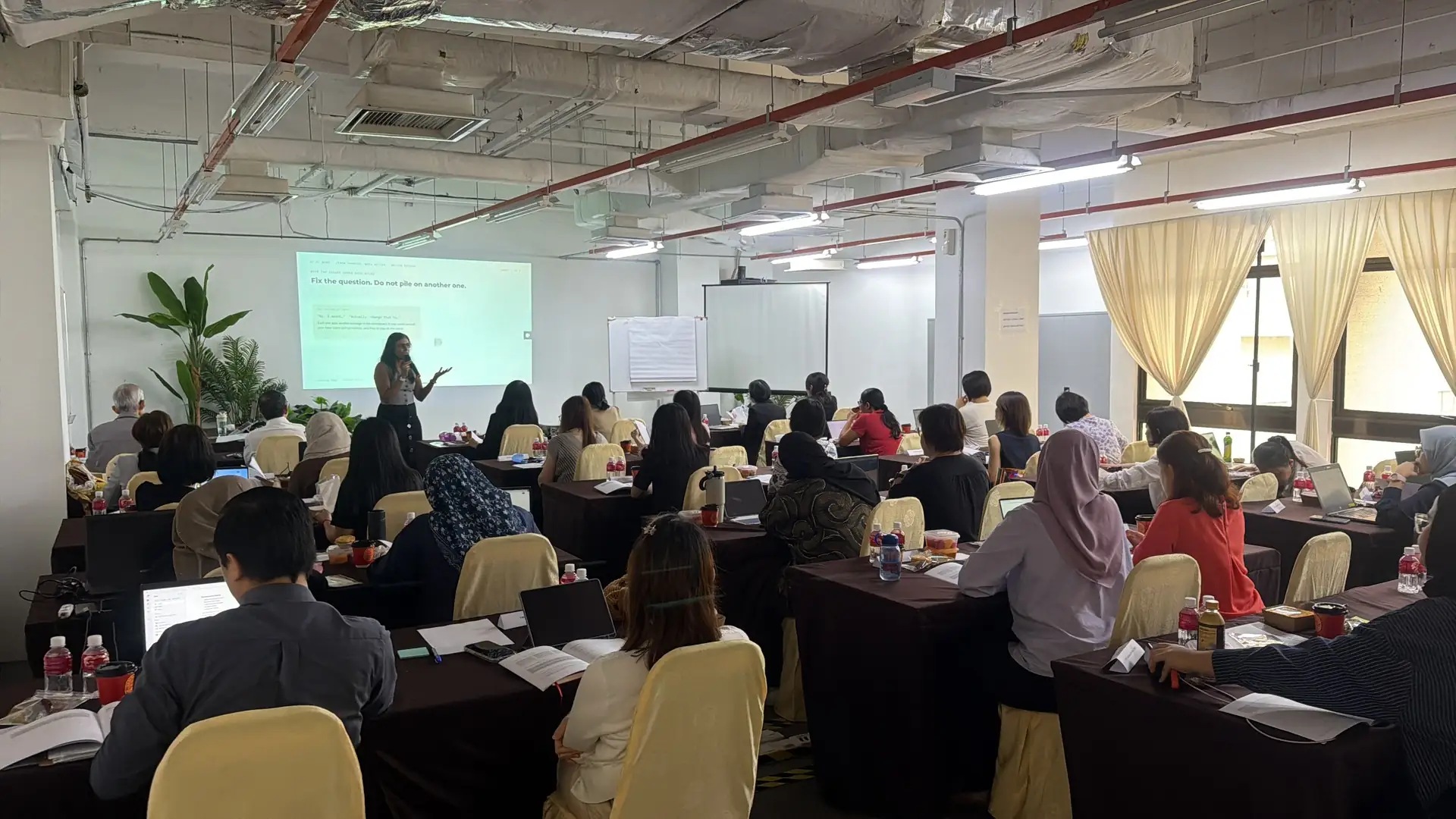
AI training works when it changes how a team does specific pieces of its work, not when it teaches people what a tool can do. Most programmes in Malaysia are tool tours: a day of features and prompts, high energy in the room, and three months later the same work done the same way. The organisations that get value start from the work, decide what good use looks like, and make managers go first.
Your people are almost certainly using AI already. Microsoft’s 2024 Work Trend Index found that 84 percent of Malaysian knowledge workers were using AI at work. So the question facing most HR and business leaders is no longer whether to introduce it. It is why so little has changed, given how many people are already using it.
The usual answer is more training. A vendor runs a session on prompting, a few enthusiasts become power users, everyone else goes back to doing things the way they did before, and the organisation concludes it needs a better course.
That conclusion is the problem.
Why doesn’t AI training change how people work?
Because it trains the tool, and the tool was never what was missing.
Most AI training answers the question “what can this do?” Participants leave knowing how to write a prompt, summarise a document and draft an email. Then they return to a job that has not been redesigned around any of it, a manager who has not used it, and no clear sense of what they are allowed to put into it.
Knowing what a tool can do is not the same as changing how you work. This is the same gap we see in every other kind of training: the distance between knowing and doing is not closed by more knowing. A finance executive who still builds the monthly report by hand after an AI workshop is rarely confused about how the tool works. Nobody has decided that the report should now be built differently, nobody has checked whether the AI-assisted version is accurate enough, and doing it the old way carries no risk.
None of that is fixed by a better slide deck on prompting.
Our founder, Perthpal Singh Khosa, made a version of this point publicly before AI training became fashionable. Commenting on national training spend in 2024, he told Bernama: “We must ensure that the programmes we invest in deliver results.” AI training is now the place where that test is failed most often, because it is the easiest training to make exciting and the hardest to make stick.
Where do AI training programmes usually go wrong?
In our experience, the failures fall into five patterns, and most programmes contain more than one.
They teach features instead of work. The session is organised around what the tool does, not around the tasks your people actually perform. Participants see impressive demonstrations that have nothing to do with their Tuesday afternoon.
Everyone gets the same course. A procurement officer, a customer service lead and a regional sales manager use AI for completely different things. A single generic programme gives each of them about a third of what they need.
Nobody says what is allowed. People are unsure which data they can paste into which tool, so the careful ones avoid it and the confident ones use it quietly without telling anyone. In many Malaysian organisations, where people are reluctant to raise a question that might look like they are doing something wrong, the uncertainty is never surfaced. It just shows up as uneven, invisible adoption.
Managers do not go first. If the team leader has never used the tool in front of the team, the message received is that AI is something for juniors to experiment with, not how the work is now done. Change made at the top and ignored by the middle does not reach the front line.
Nothing is measured. The programme reports attendance and satisfaction scores. Nobody can say whether a single task now takes less time, needs less rework or produces a better result.
What should AI training for employees actually cover?
Start from the work, not the tool. A useful programme answers four questions for each group of people, in this order.
1. Which of our tasks should change? Before any training is designed, identify the specific pieces of work where AI should make a measurable difference: drafting first versions of proposals, summarising long reports, preparing meeting notes, analysing survey comments, answering routine queries. Be specific. “Improve productivity” is not a task.
2. What does good use look like for that task? For each task, agree what the new way of working is, what still needs human judgement, and how the output is checked before it goes anywhere. This is where most of the real value sits, and it is the part most courses skip.
3. What are the rules? Which tools are approved, what information must never go into them, and who to ask when unsure. Clear rules make careful people more willing to use AI, not less.
4. How do we practise it on real work? People should leave having done their own tasks with AI, with feedback, not having watched a trainer do someone else’s. Then they need a reason and a reminder to keep doing it once they are back at their desks.
If a programme cannot show you how it answers those four questions for your organisation, it is a tool tour.
Who should go through AI training first?
Managers, before their teams.
It is tempting to start with the enthusiastic early adopters, or to train everyone at once. Both tend to fail for the same reason: the people who decide how work is actually done day to day have not changed their own habits.
When a manager uses AI to prepare for a meeting, shares the output and is open about where it needed correcting, the team learns three things at once: that it is expected, that it is safe, and that it still needs checking. No policy document teaches that as quickly.
This matters more in organisations with a strong sense of hierarchy, where people take their cue from what their seniors do rather than what they say.
How do you measure whether AI training worked?
The same way you would measure any change in behaviour: before and after, on the specific tasks you chose at the start.
For each task, record a baseline before the programme. How long does it take? How often does it need rework? Who does it? Then measure the same things a few months later. If you started from real work, these numbers are easy to collect. If you started from a list of tool features, there is nothing to measure.
Two things are worth watching beyond time saved. First, quality: faster is not better if more errors reach clients. Second, spread: whether the new way of working is used by most of the team, or only by the two people who were already enthusiastic.
Is AI training HRD Corp claimable?
AI programmes can be claimed under HRD Corp when they are run by a registered training provider as a registered programme, in the same way as other training. Check two things before you commit: that the specific programme is registered, and how much of the fee the levy actually covers. For programmes priced above HRD Corp’s prescribed rates, the levy covers part of the fee and the employer pays the difference.
We cover how claims work in more detail in our guide to what qualifies as HRD Corp claimable and on our HRD Corp page.
Five questions to ask an AI training provider
Before you commit to a programme, ask:
- Which of our tasks will this change, and how will we know? If the answer is a list of tool features, keep looking.
- Will the content differ by role? A single programme for everyone is a sign it was not designed around your work.
- What do participants practise on? Their own work, or generic examples?
- What happens after the session? Look for follow-up, reinforcement and a plan for managers, not a certificate.
- What will you measure, and when? Attendance is not an outcome.
A good provider will want to understand your work before proposing a programme. If the proposal arrives before the questions, that tells you what kind of training it is.
The real question is not which tool
The pressure to “do something about AI” is real, and it is tempting to answer it with a training day that everyone enjoys. But AI changes nothing until it changes how specific work gets done, by specific people, checked in a specific way.
As Perthpal put it when Malaysia’s National AI Office was launched in December 2024, the training industry “must shift its focus from traditional skills to future-ready capabilities.” The shift that matters most is not from soft skills to AI. It is from training people on what a tool can do to changing what they actually do.
If you are planning AI training and want it to show up in the work rather than the feedback forms, start with a training needs analysis that asks what is not working, or look at our AI training programmes, built around your people’s real work. Our faculty includes Dr Harjinthar Singh, who trains organisations in generative and agentic AI.
Frequently asked questions
What is AI training for employees?
AI training for employees teaches staff to use AI tools on their actual work. Effective programmes start by identifying which tasks should change, agree what good use and human checking look like, set clear rules on data, and have people practise on their own tasks rather than generic examples.
Why doesn’t AI training work in most organisations?
Because it usually teaches what a tool can do rather than changing how work is done. Without redesigned tasks, clear rules and managers who use it themselves, most people return to their old way of working within weeks.
Is AI training in Malaysia HRD Corp claimable?
It can be, when the programme is registered and delivered by a registered training provider. For programmes priced above HRD Corp’s prescribed rates, the levy covers part of the fee and the employer pays the difference.
Who should attend AI training first?
Managers. Teams take their cue from what their managers actually do, so when managers use AI openly and show how they check the output, adoption spreads faster and more safely than when training starts with enthusiasts or with everyone at once.